- Table of Contents
- Introduction
- 2- Conceptual Framework
- Rethinking Learning and Work Integration
- Learning in the Flow of Work
- Microtraining as an Enabling Mechanism
- Microlearning vs Microtraining
- 3- Limitations of Traditional Training Models
- Time Inefficiency
- Low Retention and Cognitive Overload
- Lack of Contextual Application
- Misalignment with Workplace Needs
- Need for Adaptive Learning Models
- 4- Theoretical Foundations
- Cognitive Load Theory
- Just-in-Time Learning
- Spaced Repetition
- Adult Learning Theory (Andragogy)
- Integrated Theoretical Basis
- 5- Microtraining Within Daily Workflows
- Integration of Learning and Work Execution
- Context-Triggered Learning
- Examples of Contextual Delivery
- Core Integration Methods
- Design Characteristics of Workflow Learning Tools
- Workflow-Based Learning vs External Training
- Organizational Impact
- 6- Enabling Technologies
- 1- Learning Experience Platforms (LXPs)
- 2- Mobile Learning
- 3- AI-Driven Recommendations
- 4- Chatbots and Digital Assistants
- 5- Integration with Workplace Tools
- 7- Applications Across Sectors
- 1- Corporate and Business Environments
- 2- Non-Governmental Organizations (NGOs)
- 3- Healthcare Sector
- 4- Technology Sector
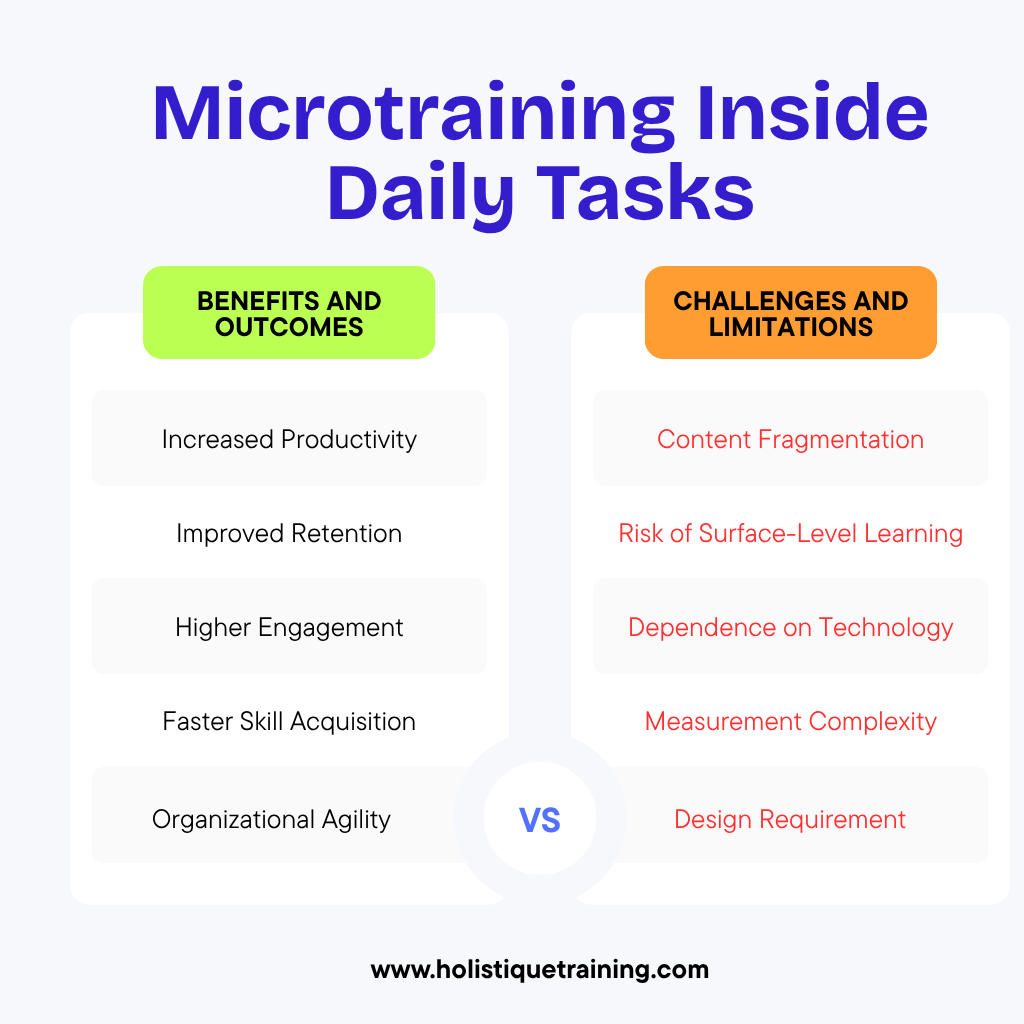
- 8- Benefits and Outcomes
- 1- Increased Productivity
- 2- Improved Retention
- 3- Higher Engagement
- 4- Faster Skill Acquisition
- 5- Organizational Agility
- 9. Challenges and Limitations
- Content Fragmentation
- Risk of Surface-Level Learning
- Dependence on Technology
- Measurement Complexity
- Design Requirement
- 10. Measuring Effectiveness
- Key Performance Indicators (KPIs)
- Feedback Mechanisms
- Data-Driven Evaluation
- Alignment with Organizational Goals
- 11. Best Practices for Implementation
- Alignment with Work Tasks
- Content Design Principles
- Accessibility and Delivery
- Continuous Updating
- Organizational Support
- Artificial Intelligence Integration
- Adaptive Learning Systems
- Predictive Learning Models
- Integration with Performance Management
- 13- Conclusion
1- Introduction
Workplace learning is undergoing a profound transformation driven by rapid technological advancement, evolving labour market demands, and the increasing pressure on organisations to maintain productivity while continuously developing employee capabilities. The pace at which new tools, systems, and professional requirements emerge has significantly shortened the lifespan of skills, making continuous learning a necessity rather than an option. At the same time, employees operate in environments where time is limited, performance expectations are high, and interruptions to workflow are costly. This creates a structural tension between the need for ongoing learning and the practical limitations of traditional training models. Conventional approaches to learning and development, such as classroom-based training, workshops, and scheduled courses, are increasingly misaligned with these realities. They require employees to disengage from their daily tasks, often leading to productivity loss and operational disruption, while also delivering knowledge that may not be immediately applicable. Research into the forgetting curve demonstrates that a significant portion of information learned in such settings is quickly lost if not applied, with studies showing that learners may forget up to 70 percent of new information within a short period.
In response to these limitations, organisations are exploring more integrated approaches to learning that align closely with real work processes. One of the most significant developments in this area is the concept of learning in the flow of work, supported by microtraining as a practical implementation strategy. This approach embeds learning directly into daily tasks, allowing employees to acquire and apply knowledge simultaneously without disrupting workflow. The central argument of this article is that microtraining enhances workplace performance by embedding context-specific, cognitively efficient learning into everyday activities, thereby improving retention, engagement, and organisational adaptability while maintaining productivity.
2- Conceptual Framework
Rethinking Learning and Work Integration
The conceptual basis of learning in the flow of work and microtraining rests on the premise that learning and working are no longer separate processes. In contemporary organizational environments, knowledge is not only acquired in advance and later applied; it is continuously developed and refined during task execution.
Learning in the Flow of Work
Learning in the flow of work refers to an approach where learning is embedded directly within daily tasks. Employees access relevant knowledge at the exact moment it is needed. This model is grounded in three core principles:
- Immediacy: Learning occurs at the point of need, minimizing the delay between acquisition and application.
- Contextualization: Knowledge is directly tied to the task or situation, improving relevance and applicability.
- Relevance: Only essential information is delivered, reducing cognitive overload and improving efficiency.
Microtraining as an Enabling Mechanism
Microtraining operationalizes this framework by delivering short, targeted learning units aligned with specific tasks or skills. While it is often confused with microlearning, its defining feature is its direct focus on performance and immediate application.
Microlearning vs Microtraining
Aspect | Microlearning | Microtraining |
Scope | General knowledge | Task-specific |
Purpose | Understanding | Performance |
Duration | 2–10 minutes | 2–5 minutes |
Context | Broad or general | Work-specific |
Application | Optional | Immediate |
Microtraining is therefore characterized by brevity, precision, and a strong focus on action. It transforms learning from a separate activity into an embedded component of work execution.
3- Limitations of Traditional Training Models
Time Inefficiency
Conventional training models often require employees to disengage from their primary tasks to attend scheduled sessions. This creates productivity losses and disrupts operational workflows, making such approaches less viable in fast-paced environments.
Low Retention and Cognitive Overload
Traditional training is strongly associated with low knowledge retention due to the way human memory decays over time. The Ebbinghaus Forgetting Curve explains that information is lost rapidly after learning if it is not reviewed or applied, with a steep decline occurring within the first days and a continuing gradual decrease thereafter. The SimplyPsychology overview of the forgetting curve further emphasizes that retention significantly improves only when information is actively reinforced through repetition or practical use.
This challenge becomes more severe in conventional training formats where large amounts of content are delivered in a single session. Such concentrated input overwhelms working memory, increases cognitive load, and reduces the brain’s ability to process and store information effectively. As a result, long-term retention declines and much of the learned material is quickly forgotten without structured reinforcement.
Lack of Contextual Application
A key limitation is the disconnect between training content and actual job tasks. Learning is often delivered in abstract or generalized formats, making it difficult for employees to translate knowledge into practical action.
Misalignment with Workplace Needs
There is frequently a gap between training content and immediate job requirements. The LinkedIn Workplace Learning Report highlights that many employees experience learning programs as not sufficiently aligned with their day-to-day job needs, particularly in fast-changing work environments where skills must be applied immediately. It also emphasizes that this lack of alignment reduces learner engagement and limits the perceived value of training within organizations.
This misalignment means that employees often complete training without being able to directly apply it to their current tasks, which weakens both retention and performance impact.
Need for Adaptive Learning Models
These limitations collectively highlight the necessity for more adaptive approaches that integrate learning directly into workflows, ensuring relevance, immediacy, and usability.

Explore whether nano-degrees are the future of higher education, their benefits, limits, and growing role in skills-based learning.
4- Theoretical Foundations
Cognitive Load Theory
Cognitive Load Theory (John Sweller) posits that working memory has limited capacity, meaning that learners can only process a restricted amount of information at any given time. When instructional content exceeds this capacity, cognitive overload occurs, leading to reduced comprehension, weaker retention, and lower learning effectiveness. As described in the ScienceDirect overview of Cognitive Load Theory, effective instructional design must therefore manage intrinsic, extraneous, and germane load to optimise learning outcomes and prevent unnecessary mental strain.
Microtraining aligns directly with this theory by segmenting complex content into small, structured, and focused learning units. This reduces extraneous cognitive load and allows learners to process information more efficiently, thereby improving understanding, retention, and application in workplace contexts
Just-in-Time Learning
Just-in-Time Learning emphasizes delivering knowledge precisely when it is required. This approach aligns with workplace demands where employees need immediate, actionable information rather than abstract preparation.
Spaced Repetition
Spaced Repetition demonstrates that learning is more effective when information is revisited over time. Microtraining supports this principle by embedding repeated short learning interactions within daily workflows, strengthening retention.
Adult Learning Theory (Andragogy)
Malcolm Knowles’ Adult Learning Theory states that adult learners are self-directed, problem-centered, and motivated by immediate applicability. Microtraining aligns strongly with these characteristics by enabling autonomous access to targeted content that can be directly applied to real tasks.
Integrated Theoretical Basis
Together, these theories explain the effectiveness of microtraining as a learning model. It is not only operationally efficient but also strongly aligned with cognitive and pedagogical principles relevant to adult workplace learning.
5- Microtraining Within Daily Workflows
Integration of Learning and Work Execution
Microtraining is most effective when embedded directly into daily workflows. In this model, learning becomes part of task execution rather than a separate training activity. Employees access knowledge while actively performing their work, which makes the learning process more relevant, immediate, and practical.
Context-Triggered Learning
Context-triggered learning means that learning is activated by specific tasks, actions, or challenges employees face during their work. Employees receive relevant information without leaving their work environment, allowing them to solve problems, complete tasks, and build skills at the same time.
Examples of Contextual Delivery
Contextual delivery can include system prompts that explain how to complete a function, short instructional videos that demonstrate best practices, and on-demand guidance integrated into operational tools. These examples show how learning can be delivered exactly when employees need support, rather than before or after the task.
Core Integration Methods
The core integration methods of microtraining include embedded software prompts within digital systems, in-application guidance tools, short instructional videos aligned with tasks, and checklists that support structured task completion. These methods help employees access essential information quickly while remaining focused on their workflow.
Design Characteristics of Workflow Learning Tools
Workflow learning tools should be non-intrusive and minimally disruptive. They need to be highly focused and task-specific, providing only the essential information required for execution. This prevents cognitive overload and ensures that learning supports productivity instead of interrupting it.
Workflow-Based Learning vs External Training
Feature | Workflow-Based Learning | External Training |
Timing | Immediate | Scheduled |
Relevance | High | Variable |
Application | Instant | Delayed |
Engagement | High | Moderate |
Productivity Impact | Minimal disruption | Interruptive |
Organizational Impact
Embedding learning into workflows creates a continuous learning environment. It strengthens both performance and skill development simultaneously because employees learn while completing real tasks. As a result, learning becomes more relevant, efficient, and engaging for employees.

Explore microlearning—its benefits, challenges, and how short, focused content boosts engagement, retention, and workplace performance.
6- Enabling Technologies
1- Learning Experience Platforms (LXPs)
Learning Experience Platforms represent a central technological foundation for the implementation of microtraining, as they enable organizations to deliver highly personalised and adaptive learning experiences. Unlike traditional Learning Management Systems, which focus primarily on content distribution and compliance tracking, LXPs prioritize user engagement, personalisation, and continuous learning. They leverage data analytics to understand user behavior, track learning patterns, and identify skill gaps, allowing them to recommend content that is directly relevant to individual roles and tasks. This personalisation ensures that employees are not overwhelmed with unnecessary information but instead receive targeted learning interventions that align with their immediate needs. As a result, LXPs play a critical role in embedding learning into the workflow, making microtraining both efficient and effective.
2- Mobile Learning
Mobile learning technologies significantly enhance the accessibility and flexibility of microtraining by allowing employees to access learning materials anytime and anywhere. In modern work environments, where employees may be distributed across locations or frequently on the move, the ability to engage with learning content through mobile devices is essential. Microtraining modules, designed to be short and focused, are particularly well-suited for mobile delivery, as they can be consumed in brief moments during the workday. This accessibility ensures that learning is not confined to specific times or locations, but instead becomes an ongoing, integrated process that supports continuous skill development.
3- AI-Driven Recommendations
Artificial intelligence plays an increasingly important role in enhancing the effectiveness of microtraining by enabling personalised and adaptive learning experiences. AI systems analyze user interactions, performance data, and behavioral patterns to identify learning needs and deliver relevant content at the right time. This predictive capability allows organizations to move from reactive to proactive learning strategies, where employees receive guidance before gaps in knowledge impact performance. By ensuring that learning is both timely and relevant, AI-driven recommendations significantly improve engagement, retention, and overall learning outcomes.

The rise of artificial intelligence is reshaping how we think, learn, and solve problems. In today’s fast-changing world, learning is no longer a linear process—it’s a dynamic interaction between human insight and machine intelligence. This course introduces the concept of hybrid intelligence and empowers participants to
4- Chatbots and Digital Assistants
Chatbots and digital assistants provide real-time support within workflows, making them valuable tools for delivering microtraining. These systems can respond instantly to user queries, provide step-by-step guidance, and direct employees to relevant learning resources without requiring them to leave their tasks. This immediacy aligns with the principles of learning in the flow of work, as it allows employees to access knowledge exactly when they need it. By reducing the time spent searching for information and minimizing workflow interruptions, chatbots and digital assistants contribute to a more efficient and responsive learning environment.
5- Integration with Workplace Tools
The integration of microtraining into workplace tools such as CRM and ERP systems is essential for ensuring that learning is embedded directly into daily operations. This integration allows learning content to be delivered within the same platforms that employees use to perform their tasks, eliminating the need to switch between systems. As a result, learning becomes a natural part of the workflow rather than an additional activity. This seamless integration not only improves accessibility but also increases the likelihood that learning will be applied immediately, enhancing both effectiveness and efficiency.
7- Applications Across Sectors
1- Corporate and Business Environments
In corporate and business settings, microtraining is widely used to support onboarding, sales training, and customer service operations. New employees can quickly acquire the knowledge and skills needed to perform their roles through short, task-specific modules, reducing the time required to reach full productivity. In sales environments, microtraining provides continuous updates on products, market trends, and customer engagement strategies, enabling employees to respond effectively to client needs. This approach ensures that learning remains relevant and directly linked to performance outcomes.
2- Non-Governmental Organizations (NGOs)
In NGOs, microtraining is particularly valuable due to the dynamic and resource-constrained environments in which these organizations operate. Research on digital learning and capacity building in humanitarian organizations highlights that such contexts are often characterized by fragility, limited resources, and the need for rapid, context-specific responses, where digital learning enhances employees’ performance by strengthening their capacity and resilience in real time. Field workers frequently face complex and unpredictable situations that require immediate access to practical knowledge.
Microtraining provides short, focused modules on topics such as community engagement, reporting procedures, and operational guidelines, enabling staff to respond effectively in real time. This aligns with findings that digital learning tools and capacity-building approaches in humanitarian settings support timely access to information and improve operational effectiveness in challenging environments. Overall, this approach enhances both efficiency and impact, especially in contexts where timely decision-making is critical.
3- Healthcare Sector
In healthcare, microtraining plays a crucial role in ensuring that professionals remain up to date with procedures, safety protocols, and compliance requirements. Given the high-stakes nature of healthcare environments, where errors can have serious consequences, the ability to access accurate and relevant information quickly is essential. Microtraining supports this need by delivering concise, targeted content that can be applied immediately, helping to maintain high standards of care and reduce the risk of mistakes.
4- Technology Sector
The technology sector is characterized by rapid innovation and continuous change, making ongoing learning a necessity for professionals in this field. Microtraining enables developers, engineers, and IT specialists to stay current with new tools, programming languages, and frameworks through short, focused learning modules. By integrating learning into the workflow, microtraining allows professionals to solve problems and acquire new skills without interrupting their work, supporting both productivity and innovation.
8- Benefits and Outcomes
1- Increased Productivity
Microtraining enhances productivity by allowing employees to learn without stepping away from their tasks. By embedding learning into the workflow, it eliminates the need for lengthy training sessions that disrupt operations. Employees can access relevant information quickly and apply it immediately, ensuring that learning supports rather than hinders performance.
2- Improved Retention
The structure of microtraining, which delivers information in small, focused segments, aligns with cognitive principles that support memory retention. By reducing cognitive overload and enabling immediate application, microtraining helps employees retain information more effectively over time. This leads to better long-term performance and reduces the need for repeated training.
3- Higher Engagement
Microtraining increases engagement by providing content that is directly relevant to employees’ current tasks and challenges. Unlike traditional training, which can feel disconnected from daily work, microtraining is practical and immediately useful. This relevance motivates employees to actively engage with learning materials, improving participation and outcomes.
4- Faster Skill Acquisition
By enabling a learn-by-doing approach, microtraining accelerates the process of skill acquisition. Employees can apply new knowledge immediately within their work context, reinforcing learning and building competence more quickly. This is particularly valuable in fast-paced environments where rapid skill development is essential.
5- Organizational Agility
Microtraining supports organizational agility by allowing companies to quickly update and distribute learning content in response to changing conditions. Whether adapting to new technologies, regulatory requirements, or market trends, organizations can ensure that employees have the knowledge they need to respond effectively. This flexibility enhances competitiveness and resilience in dynamic environments.
9- Challenges and Limitations
Content Fragmentation
Breaking learning into small units can lead to a lack of overall structure. Without careful design, the coherence between modules may be reduced, making it harder for learners to build a complete understanding of a topic.
Risk of Surface-Level Learning
Microtraining may oversimplify complex topics. Some subjects require deeper and more sustained engagement than short modules can provide, which can limit conceptual depth.
Dependence on Technology
Effective delivery depends on access to digital tools and stable platforms. In contexts with limited infrastructure or connectivity, implementation can be restricted.
Measurement Complexity
It is difficult to directly link microtraining to performance outcomes. Measuring its impact often requires multi-variable analysis, as many external factors influence performance.
Design Requirement
These challenges highlight the need for strong instructional design and carefully structured implementation to ensure coherence, depth, and effectiveness.
10- Measuring Effectiveness
Key Performance Indicators (KPIs)
Performance improvement after training, reduction in operational errors, and engagement or usage metrics are commonly used indicators to evaluate effectiveness.
Feedback Mechanisms
Continuous user feedback is used to refine and improve content. Iterative updates ensure that learning materials remain relevant and usable over time.
Data-Driven Evaluation
Learning analytics track user behavior and interaction patterns. This data helps assess outcomes and identify gaps in learning design or delivery.
Alignment with Organizational Goals
Measurement ensures that microtraining contributes to broader organizational performance objectives. Evaluation frameworks link learning activities directly to operational impact.
11- Best Practices for Implementation
Alignment with Work Tasks
Learning content must directly reflect real job responsibilities. Research emphasizes the importance of embedding learning into daily workflows to ensure relevance and application.
Content Design Principles
Learning units should remain concise and focused while maintaining high relevance to immediate job needs.
Accessibility and Delivery
Content should be accessible across devices such as mobile, desktop, and embedded systems. Barriers to access during work execution should be minimized.
Continuous Updating
Content must be regularly revised to reflect changes in processes, systems, or organizational needs, ensuring ongoing accuracy and relevance.
Organizational Support
Management involvement is essential for successful adoption. Leadership support strengthens engagement and reinforces integration into workflows.
12- Future Trends
Artificial Intelligence Integration
Artificial intelligence will enable more automated and personalised microtraining delivery. Content will dynamically adapt based on user behavior and performance.
Adaptive Learning Systems
Learning systems will adjust difficulty and content in real time based on learner progress, increasing personalisation and responsiveness.

As artificial intelligence becomes increasingly embedded in how we work, learn, and solve problems, the ability to think adaptively is emerging as a vital skill for success. In the age of human-AI synergy, it's not just about learning new tools—it’s about shifting how we approach challenges, make decisions,
Predictive Learning Models
Advanced analytics will anticipate learning needs before performance gaps appear, shifting training approaches from reactive to proactive.
Integration with Performance Management
Microtraining will become more closely connected with performance evaluation systems. Learning outcomes will increasingly inform workforce development decisions and strategies.
13- Conclusion
Learning in the flow of work represents a shift from treating learning as a separate activity to embedding it directly within daily work processes. Microtraining operationalizes this approach by delivering short, task-specific learning interventions that improve efficiency, relevance, and immediate performance. While it does not replace traditional training, it complements it by addressing real-time, operational learning needs that conventional models often fail to support.
As workplace demands continue to evolve, microtraining is expected to become increasingly important within organizational learning strategies. Its integration with digital tools, data analytics, and emerging technologies such as artificial intelligence will further enhance its adaptability and personalisation, positioning it as a central component of future workplace learning systems.